Situation Report
Operation Epic Fury — the US designation for the joint US-Israeli campaign — launched on 28 February 2026, with approximately 900 strikes executed in the first 12 hours. Israeli forces contributed an estimated 200 aircraft hitting nearly 500 targets across Iranian territory. Confirmed targets included ballistic missile launch infrastructure, nuclear enrichment facilities, naval assets, and command nodes. In the opening hours, Israeli airstrikes confirmed the assassination of Supreme Leader Ali Khamenei — a decapitation strike with no precedent in the history of US-aligned operations against a state actor.
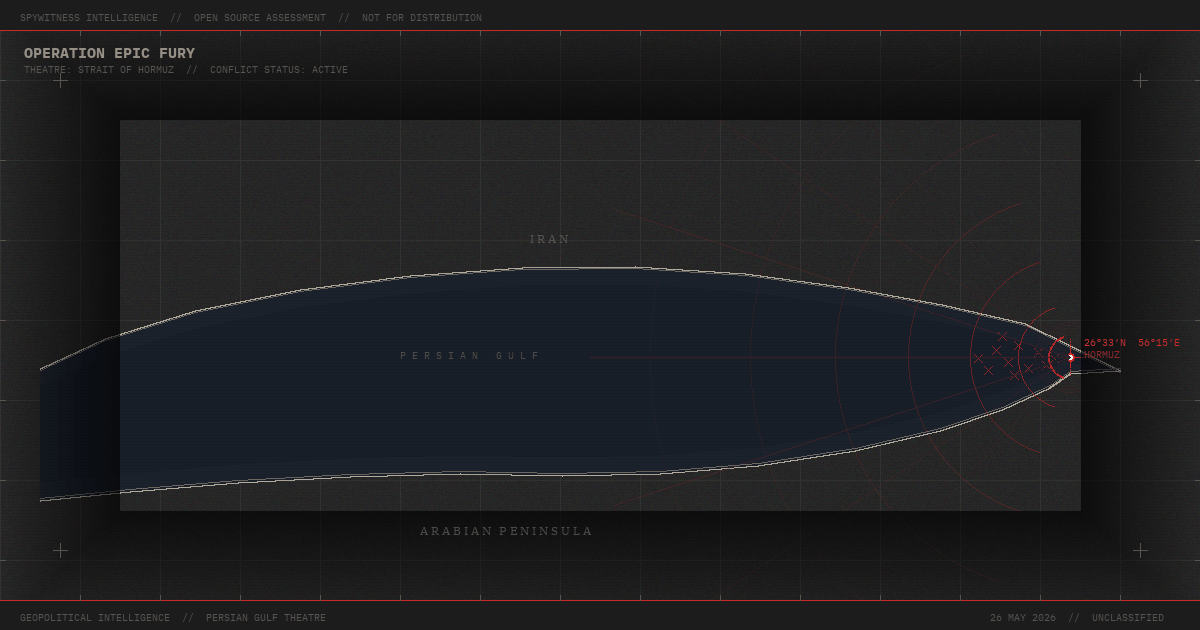
Iran responded under Operation True Promise IV within 48 hours, extending the conflict to seven countries. By 5 May, US officials declared the offensive phase concluded. A ceasefire was subsequently declared, though US Central Command has confirmed that strikes against Iranian assets have continued under self-defence authorities — including the 25 May interdiction of IRGC vessels detected emplacing mines in the Strait. The IRGC claims it downed a US MQ-9 Reaper drone and engaged an F-35 during the same period. Neither claim has been independently verified.
Talks are continuing in Doha under Qatari mediation. A draft one-page memorandum of understanding is reportedly under discussion, centred on three core elements: an Iranian moratorium on nuclear enrichment, US sanctions relief and release of billions in frozen Iranian assets, and mutual commitment to freedom of navigation through the Strait of Hormuz within a 60-day framework for final negotiations.
Background and Context
The trajectory toward open conflict accelerated through late 2025, as the Trump administration's diplomatic posture hardened around two non-negotiable positions: prevention of Iranian nuclear weapons capability and unconditional access to the Strait of Hormuz. The Islamic Republic, simultaneously weakened by degraded proxy capacity and emboldened by its enriched uranium leverage, miscalculated Washington's threshold for direct military action.
The leadership vacuum created by Khamenei's assassination proved brief. An Interim Leadership Council — comprising Guardian Council representative Alireza Arafi, Chief Justice Gholam-Hossein Mohseni-Eje'i, Parliamentary Speaker Mohammad Bagher Ghalibaf, and President Masoud Pezeshkian — assumed constitutional authority on 1 March. Within eight days, the Assembly of Experts had named Mojtaba Khamenei, the Supreme Leader's 56-year-old son, as successor. Mojtaba has never stood for public office, holds deep and documented ties to the IRGC senior command, and is assessed as likely to prioritise institutional survival of the Islamic Revolutionary system over any strategic accommodation with Washington. His elevation is not a signal of moderation.
Iran's regional proxy architecture — once the cornerstone of its deterrence model — has been comprehensively degraded. Hezbollah entered 2026 already in terminal decline following its military defeat by Israel during the Gaza war and the collapse of Bashar al-Assad's regime in Syria. The Houthis' operational capacity in Yemen has been severely reduced. Iraq-based militia influence has been further constrained by the Trump administration's explicit rejection of their participation in the Iraqi political process. Iran no longer possesses the distributed deterrence force it once could credibly threaten to activate.
Analysis and Assessment
The ceasefire, as currently constituted, is assessed with moderate confidence as unsustainable in its present form without a binding framework agreement. Both sides have violated its terms. IRGC mine-laying operations in the Strait — if confirmed — represent not defensive preparation but a deliberate pressure instrument aimed at extracting concessions from Washington before any final deal. Iran's strategic calculus at this juncture is legible: negotiate from whatever leverage remains while avoiding the conditions that would invite a renewed offensive. Mines in Hormuz are a message, not a military campaign.
The nuclear question is the critical fault line. Iran has agreed in principle to relinquish its highly enriched uranium stockpile — assessed at over 400 kilograms — but refuses to enter detailed nuclear talks until a formal cessation of hostilities is signed. The United States has made the reverse a prerequisite: nuclear commitments must precede final sanctions relief. The one-page MOU framework, even if signed, defers this contradiction rather than resolves it. The 60-day negotiating window it contemplates is ambitious to the point of implausibility given the gap between the two positions.
New Supreme Leader Mojtaba Khamenei's IRGC ties introduce a further complication. It is probable that factions within the IRGC are operating with relative autonomy from Tehran's diplomatic channel — the mine-laying incident is consistent with this pattern. If the IRGC is running a parallel pressure campaign without civilian leadership authorisation, Doha is negotiating with the wrong interlocutors. The Qatari mediation channel, while valuable, does not have direct access to IRGC operational command.