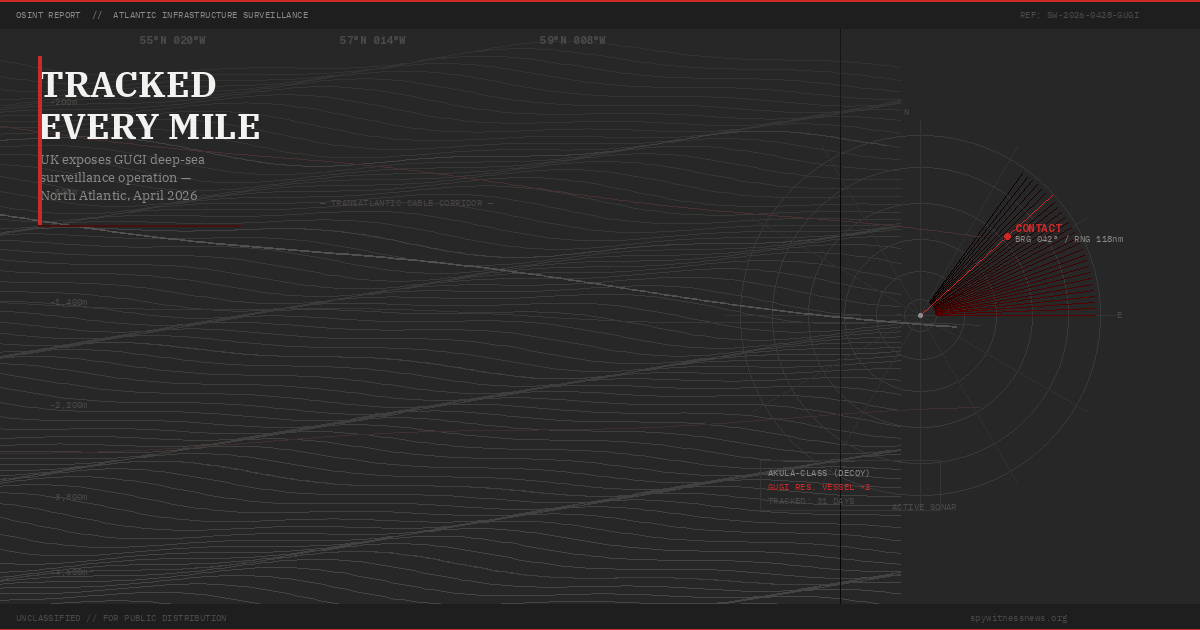
The deliberate public exposure of a covert Russian submarine operation is a calculated deterrence signal — the counter-intelligence value of disclosure assessed as outweighing the operational cost of revealing collection capability.
Intelligence Lead
A covert Russian submarine operation targeting critical undersea communications infrastructure in the North Atlantic was intercepted and publicly exposed by British and Norwegian forces in April 2026, with UK authorities confirming they tracked the vessels every mile of their month-long deployment through British waters. The operation involved specialist deep-sea research submarines belonging to Russia's Main Directorate for Deep Sea Research — GUGI — vessels purpose-built for surveying and, in conflict conditions, sabotaging the undersea cable infrastructure that carries the overwhelming majority of transatlantic data traffic. The UK's decision to expose rather than quietly terminate the operation is the analytically significant element: this is as much a deterrence message as a counter-submarine success.
Situation Report
British defence officials confirmed the operation involved three Russian vessels: an Akula-class nuclear-powered attack submarine and two GUGI specialist ships. The Akula is assessed with high confidence to have operated as a decoy asset, tasked with drawing Royal Navy surface and air surveillance resources while the two GUGI vessels conducted the primary intelligence-gathering mission along cable routes in the North Atlantic. British surveillance was maintained continuously throughout the deployment using maritime patrol aircraft, surface vessels, and airborne anti-submarine warfare assets. Norwegian forces provided support throughout the operation. All Russian units withdrew toward northern bases following public exposure of their presence.
Defence Secretary John Healey confirmed no evidence of physical damage to cables or underwater pipelines. OSINT analysis of UK maritime patrol aircraft flight patterns — conducted via open-source ADS-B tracking platforms — corroborated the extended surveillance timeline described in the official account, with RAF P-8 Poseidon activity showing a sustained operational tempo in the relevant North Atlantic corridors across the period in question.
Background and Context
GUGI is not a conventional military submarine force. The directorate operates purpose-built deep-sea research vessels — officially designated as oceanographic ships — that function as intelligence collection and infrastructure surveillance platforms during peacetime, and as sabotage-capable assets in conflict scenarios. GUGI vessels have a well-documented history of suspicious activity near undersea cable nodes, and their capabilities include placing wiretaps, mapping cable infrastructure to support contingency planning, and deploying the equipment that would sever or disrupt those cables in a conflict scenario.
The North Atlantic cable network carries an estimated 95% of transatlantic data traffic, including financial transactions, government communications, and military coordination channels. Disruption or degradation of these cables at the outset of a NATO-Russia conflict would represent a significant strategic effect on Western communication and intelligence architectures. The GUGI mission in April is best understood as reconnaissance for that contingency.
Analysis and Assessment
The Akula's role as a deliberate decoy merits particular analytical attention. It confirms Russian submarine operations in sensitive areas now incorporate active deception measures designed to exhaust allied anti-submarine resources and create surveillance windows for specialist vessels. This represents a meaningful tactical evolution beyond simple stealth operations.
The UK's choice to publicly expose the operation — with named vessel types, operational duration, and an explicit description of GUGI's sabotage mandate — is a deliberate act of strategic communication. The Royal Navy possessed the intelligence and the operational capability to terminate the surveillance quietly. Instead, London chose disclosure, demonstrating collection capability, denying Moscow the intelligence value of the survey, and issuing a public deterrence signal simultaneously.
Available reporting and the GCHQ Director's public speech on 27 May — delivered three weeks after the submarine operation concluded — together constitute a coordinated strategic communication campaign. The submarine exposure is the operational precedent; the GCHQ speech is the doctrinal framing. The combined message: the UK detects, tracks, and will expose hybrid operations, and the risk of miscalculation is at its highest point in recent memory.