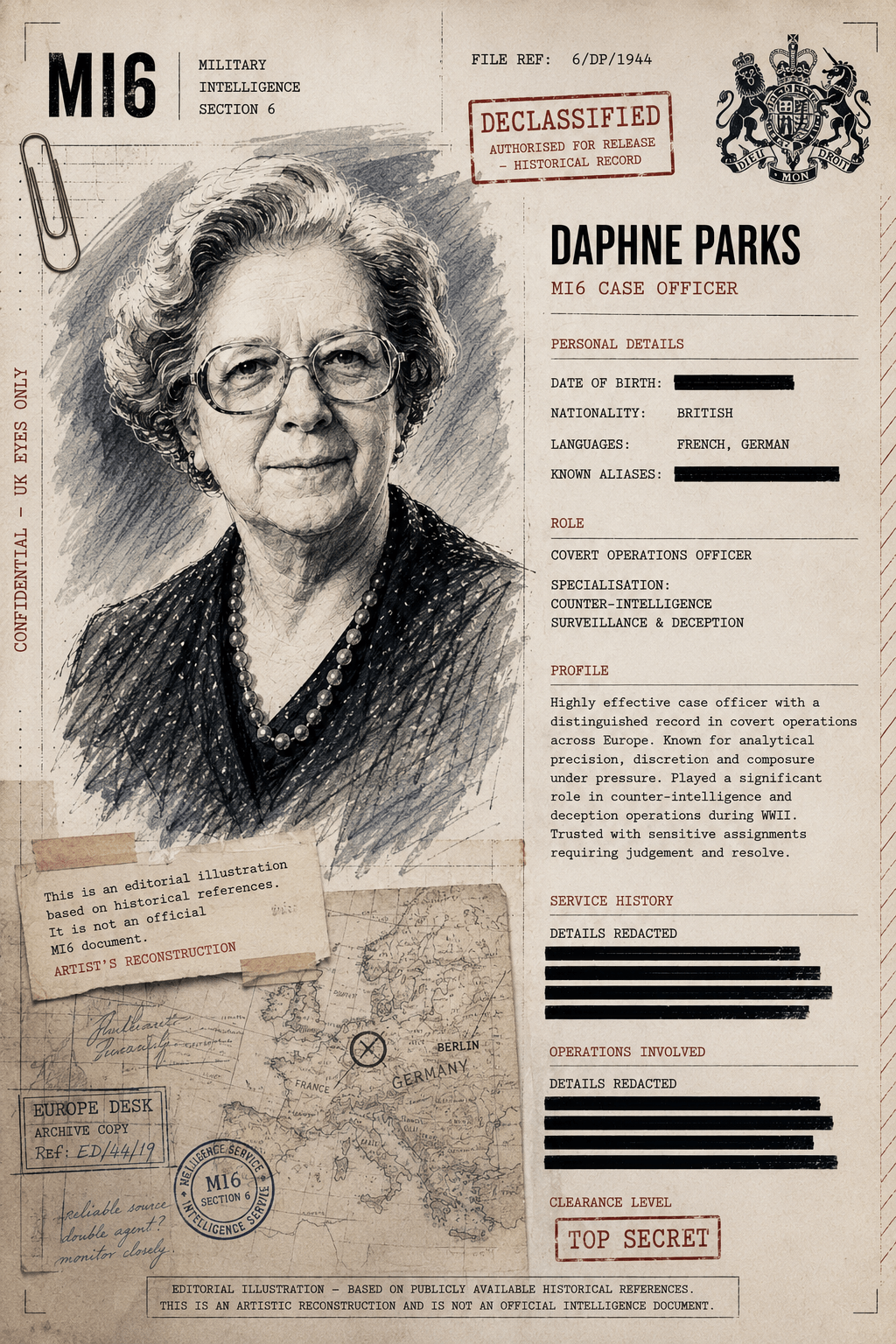
Daphne Park served as one of the Secret Intelligence Service's most effective and enduring field officers across four decades of Cold War intelligence operations, holding postings in Moscow, the Congo, Zambia, Hanoi, and Ulaanbaatar before rising to Controller Western Hemisphere — the highest operational position held by any woman in SIS history at that time. Her postings consistently placed her at the fault lines of Cold War geopolitics: Soviet penetration operations, African independence movements, and the covert contest for influence in Southeast Asia. She retired from SIS in 1979, became Principal of Somerville College Oxford, and was created a life peer in 1990.
Daphne Park entered intelligence work through the wartime Special Operations Executive, where she served as a coding instructor and dispatching officer — responsible for sending agents behind enemy lines into occupied Europe. The work was not peripheral. She briefed individuals who would not come back. That formative experience — operating at the exact boundary between decision and consequence — shaped the operational temperament that would define her subsequent career.
She joined the Secret Intelligence Service formally in July 1948, against the backdrop of the Berlin Airlift. Her first posting to Austria placed her in one of the most active intelligence environments of the early Cold War. Vienna and its surrounds in the late 1940s were a human intelligence theatre with few equivalents — the four-power occupation created a geography of overlapping jurisdictions that intelligence services on all sides exploited with barely concealed aggression. Park learned the craft in conditions that rewarded improvisation.
Moscow followed in 1954. The Soviet capital under Khrushchev was a constrained and hostile operating environment for Western intelligence officers. Surveillance was pervasive, counterintelligence resources extensive, and the social geography engineered to isolate diplomats from meaningful contact with Soviet citizens. Park navigated it. What she produced there has never been fully disclosed, but the posting established her credibility within the Service as an officer who could operate effectively against a hard target.
The Congo defined her operational reputation.
She arrived in Léopoldville in 1959 as Consul and First Secretary — diplomatic cover for what was in practice the MI6 station chief role. The timing was consequential. The Democratic Republic of Congo became independent from Belgium in June 1960, and the first months of independence collapsed rapidly into crisis: a mutinying army, Belgian military intervention, the secession of mineral-rich Katanga, and a Cold War competition for influence that drew in the United States, the Soviet Union, and Western European powers simultaneously. The stakes were not abstract. The Katanga region held uranium deposits that had supplied the Manhattan Project. Control of the Congo's mineral wealth was a strategic priority for multiple state actors.
Into this environment Park operated not from behind a desk but in the field — reportedly driving a Volkswagen Beetle across difficult terrain, transporting individuals whose lives were in immediate danger. The methods were improvised and direct. She later said, without elaboration, that she had moved people out of harm's way. The specifics remain classified.
The most consequential and contested element of her Congo posting concerns the fate of Patrice Lumumba, the Congo's first Prime Minister, who was seized in December 1960 and executed by firing squad in Katanga on 17 January 1961. Shortly before her death in 2010, Park reportedly told a fellow peer in the House of Lords — in a conversation that became the subject of subsequent disclosure — that MI6 had arranged Lumumba's elimination. According to the account, when asked directly, her response was characteristically blunt: "We did. I organised it." Her stated rationale centred on intelligence assessments that Lumumba would transfer Katangese uranium deposits to Soviet control.
The claim must be treated with analytical care. It rests on a single account of a private conversation, relayed posthumously, from a source who did not publish it contemporaneously. Historians and former officials have contested its reliability. No documentary corroboration has entered the public record. The British government has neither confirmed nor denied the account. What is not in dispute is that Park held the most senior Western intelligence position in the country at the time of Lumumba's death, that the CIA was simultaneously running a separate operation targeting Lumumba, and that the geopolitical interests she identified as motivation were real and documented. The truth of her role remains unresolved. The question itself constitutes a significant item of unfinished Cold War history.
After the Congo, Park served in Zambia from 1964 to 1967, maintaining intelligence coverage of southern African independence movements during a period of significant regional instability. Hanoi followed from 1969 to 1971, during the Vietnam War — among the most hostile and complex operating environments available to a Western intelligence officer at any point during the Cold War. A posting to Ulaanbaatar, Mongolia, preceded her return to London.
In 1975, she was appointed Controller Western Hemisphere — the highest operational rank ever held by a woman within SIS at that time. The appointment was not ceremonial. It placed her in command of intelligence operations across an entire hemisphere during a period that included the aftermath of Watergate, the Pike and Church Committee investigations into US intelligence abuses, and significant instability across Central and South America.
She retired from SIS in 1979. Somerville College, Oxford elected her as Principal the following year — a position she held until 1989, during which time she oversaw the college's transition to coeducation. Created Baroness Park of Monmouth in February 1990, she entered the House of Lords and for the following two decades served as SIS's informal parliamentary voice — available to defend, contextualise, and occasionally deflect scrutiny of the Service from within the legislature.
She died on 24 March 2010.
Daphne Park's significance to intelligence history operates on two levels that do not fully overlap. The first is operational: she demonstrated over four decades that field intelligence work in hard environments could be conducted with the same effectiveness as any officer the Service deployed, reaching the top operational rank available to her by performance rather than positioning. The second is historical. The Lumumba disclosure — whatever its ultimate evidentiary weight — placed Park at the centre of one of the Cold War's most ethically significant episodes: the Western-backed removal of a democratically elected African leader in the first weeks of his term. She left no memoir. Her operational files remain classified. What survives is largely anecdote, obituary, and a single deathbed remark that has generated more historical consequence per word than most formal intelligence disclosures. That ratio, in its way, is a fair measure of the woman.